Blogs
We provide online programming courses and tutorials suitable for all levels.
8 Dimensions of Data Quality
Published on 22 Dec 2025
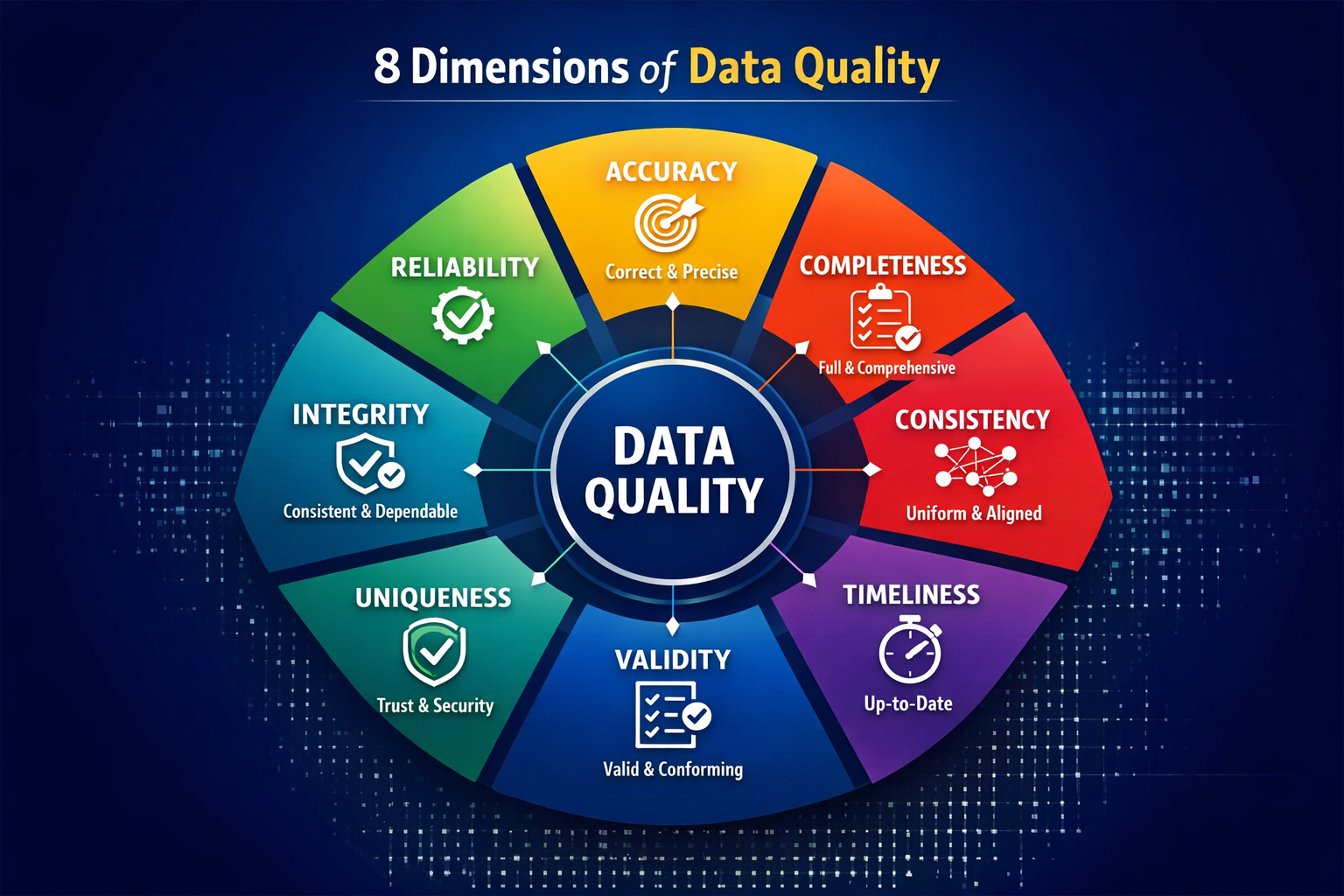
Beyond correctness, data must be consistent and valid across systems and reporting layers. The same metric should never tell a different story in finance, operations, or management reports. Consistency ensures alignment, while validity confirms that data conforms to defined business rules, formats, and policies. When these dimensions are ignored, organizations face reconciliation issues, audit observations, and delays in closing cycles, problems that are often mistaken as reporting failures but are actually data quality gaps
Accuracy
In corporate reporting, accuracy defines credibility. A single incorrect figure in revenue, headcount, or inventory can cascade into flawed forecasts and poor strategic decisions. Accuracy ensures that data reflects the real business situation, not assumptions, approximations, or outdated inputs, reducing last-minute corrections and leadership escalations.
Completeness
Incomplete data is one of the most common yet overlooked corporate challenges. Missing customer details, cost centers, or transaction dates often surface only during audits or month-end reviews. Completeness ensures that all required information is present upfront, preventing rework, reporting delays, and compliance risks.
Consistency
When the same metric shows different values across departments, trust in data erodes quickly. Consistency ensures that figures remain aligned across finance, sales, and operations, eliminating reconciliation battles and endless clarification meetings. It enables teams to focus on decisions rather than defending numbers.
Timeliness
Data that arrives late is often as harmful as incorrect data. Leadership decisions depend on current insights, not last week’s reality. Timeliness ensures that reports reflect the present business state, supporting faster responses to risks, opportunities, and operational issues.
Validity
Valid data follows defined business rules and standards. Invalid formats, incorrect classifications, or rule violations may not break reports, but they silently distort insights. Validity ensures data complies with organizational policies, regulatory requirements, and analytical logic, safeguarding decision accuracy.
Uniqueness
Duplicate records are a hidden threat in enterprise data. They inflate counts, distort performance metrics, and create confusion during reconciliations. Uniqueness ensures each business event or entity is represented once, supporting clean aggregation and reliable reporting.
Integrity
Data integrity maintains logical relationships between datasets, such as customers linked to transactions or employees linked to departments. When integrity breaks, reports may still load but tell an incomplete or misleading story. Integrity ensures structural trust across systems and analytics.
Reliability
Reliability is built over time. When data consistently produces stable, explainable results, stakeholders develop confidence in analytics. Reliable data reduces dependency on manual validation and enables organizations to scale reporting without increasing risk or effort.